How Ipiphany extracts meaning
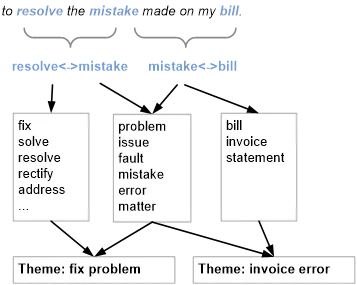
1. Natural language processing is first used to split the verbatim into sentences and then identify keywords within the text
Ipiphany extracts Keywords by
- Identifying the part of speech (POS) for all words
- Extracting those that are Nouns, Verbs, Adjectives and Adverbs
- Converting them to their base morphological form e.g. fixed -> fix, problems -> problem

2. Linguistic connections between the keywords are identified and extracted as Word Associations
Also at this stage negations are identified e.g. not, never, without

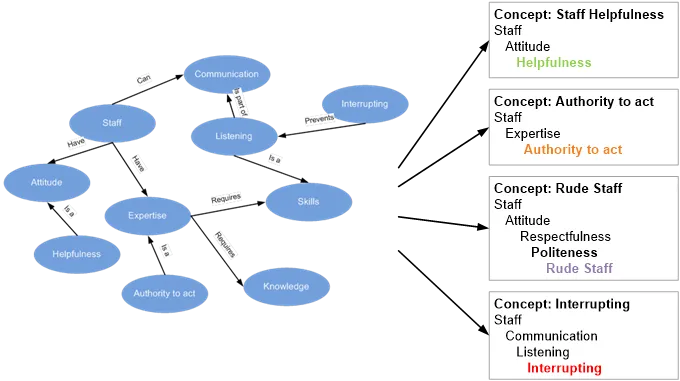
3. Semantic knowledge from ontologies is used to identify higher level concepts
Ipiphany contains a number of general and industry specific ontologies that capture knowledge about domain specific entities, events and relationships.
In addition, company or domain specific Ontologies can be used to capture knowledge specific to a company. E.g. Product names and categories
4. Further semantic processing is applied to group Keywords and Word Associations into Themes
Ipiphany uses semantic processing to understand where different words or associations have a similar meaning, and groups similar meanings into clusters called Themes.
Themes are either Broad or Narrow.
Broad Themes cluster verbatim aspects around a central
- Object (Noun) e.g. All different aspects of ‘problems’ – where problems may be identified from semantically similar keywords such as problem, issue, fault, mistake
- or Action (Verb) – e.g. All different aspects of ‘fixing’ – where ‘fixing’ may be identified from semantically similar keywords such as fix, resolve, solve, rectify
Narrow themes cluster verbatim aspects around an association between either an Object or an Action
- Action-Object e.g. ‘fix problem’ which may be identified from semantically similar associations such as fix problem, resolve issue, rectify fault
- Aspect-Object e.g. ‘cause of problem’ or ‘problem cause’ which may be identified from semantically similar associations such as root cause of problem
- Modifier-Object e.g. ‘big problem’ which may be identified from semantically similar associations such as big problem, large issue, huge fault
- Verb-Aspect e.g. ‘easy understand’ which may be identified from semantically similar associations such as easy understand, hard comprehend, difficult understand